
Free 2-Minute Assessment

When Outbursts Turn to Hitting & Biting.

Take a 2-minute screening to get a personalized safety response plan.

Why aggression is not meanness

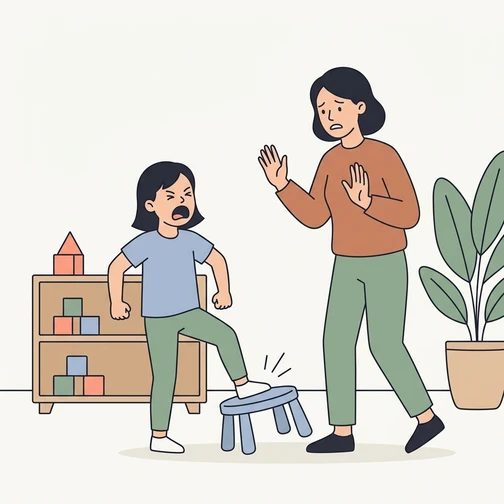
Aggression is rarely meanness. It often happens when overload, demands or big frustration use up a child's self-control.

  • Hitting can be words when words fail.

  • The brain is in fight-or-flight, not learning.

  • Punishing in the moment fuels the fire.

  • Your child has lost control, not gained it.

What is usually not helpful in the heat of the moment

  • Avoid rationalising and lecturing

    Trying to explain why hitting is bad during an emotional crisis usually adds language when the brain is least ready for it. Simple words help more.
  • Do not threaten consequences

    Taking away future rewards during an active outburst can increase panic and make the aggression escalate.
  • Do not match the intensity

    Screaming, forceful holding, or visible anger can add intense attention and accidentally keep the behaviour going.
Evidence-based sequence

Four immediate steps to re-establish safety

Enforce neutral blocking

Position yourself between your child and others. Block hits neutrally using your hands as shields or a soft cushion. Avoid eye contact and minimise speaking to prevent accidental reinforcement.

De-escalate the environment

Dim the lights, turn off loud TVs, and ask siblings to leave the room. Lowering the cumulative sensory load on your child's nervous system is the fastest path to a full co-regulation reset.

Execute a safe exit

If the environment cannot be cleared, calmly remove yourself or other children to a safe room, leaving the aggressive child in a completely trigger-free, secure space to cool down.

Delay teaching and logic

Wait at least 30 to 60 minutes after both of you are completely calm. Teaching replacement behaviours or addressing the situation is only effective when the nervous system is at baseline.

Evidence-informed

NICE recommends building a behaviour support plan that explains the function of the behaviour, adjusts the environment, and teaches an alternative skill before relying on reactive responses.

  • Identify the function of the behaviour before choosing an intervention.
  • Adapt the environment and routine to reduce triggers.
  • Teach an alternative skill and involve family or carers.
NICE NG11 — Challenging behaviour and learning disabilities

How age and context change behavioural complexity

Aggression manifests differently across developmental stages. Understanding these nuances helps determine if you need direct therapist oversight.

Complexity
5/ 10

Support intensity changes with age, language, safety, and recovery time.

Co-regulation and simple routines

First-Then board

Outbursts are usually driven by expressive language gaps and manding deficits. Toddlers resort to hitting or biting because they cannot express immediate needs.

Step-by-step plan to resolve child aggression

Each module contains a practical step-by-step guide and a concrete tool for the parent.

Module 1Map the exact triggers of aggression15 minutes

Map the exact triggers of aggression

Identify the hidden environmental and biological triggers maintaining your child's outbursts. Set up a baseline tracking system.

The Trigger Map & ABC Log Sheet

A simple, structured parent tracker to analyse the triggers and consequences of outbursts.

15 minutes
When safety comes first

Respond with confidence when your child hits or bites

Describe one unsafe episode. A specialist helps build one response so every adult protects your child and others in the same way.

  • How to stop unsafe actions without unnecessary force
  • What every adult should say and do
  • What to change before the next episode
Programme format

How you will learn to manage outbursts

Our programme is built for exhausted caregivers who need highly practical, bite-size guidance that works in real life.

  • Step-by-step tasks
  • Parent-focused assignments
  • In-situ therapist coaching
Top-level specialist support

The Role of Your Clinical Partner

We do not believe in clinical isolation. Your specialist acts as a behavioural detective, helping you decode the function of aggression.

Conducting Functional Analyses

Your therapist will help you look past the form of hitting to verify whether it is driven by escape from demands, tangible access, or attention.

Customising Safety Protocols

If your child's aggression presents safety risks, your therapist will design tailored blocking and room-clearing workflows.

Monitoring Implementation Fidelity

We check parent execution accuracy. Your specialist will observe you in-vivo or via video review, providing gentle, immediate feedback to guarantee success.

Credentials we check
BACB logoIBAO logoQABA logo
Credentials, practical experience, and parent-training track record verified

We work with behavioural therapists who have demonstrated experience in parent training and caregiver-mediated interventions—so support works in the routines your family repeats at home.

We do not believe in clinical isolation. Your specialist acts as a behavioural detective, helping you decode the function of aggression.

Parenting skills that transfer to other challenges

The behavioural methodologies you master to resolve aggression build a solid foundation of co-regulation that applies across your child's entire life.

Teaching an appropriate, low-effort communication skill that produces the same functional reward as the aggressive behaviour it replaces.

Use it nowReplacing throwing objects with a polite request for a break from academic work.

Successfully resolves picky eating food selectivity, bedtime refusal, and public screaming.

Future situationsEmpowers your child to confidently advocate for their sensory and academic needs in primary school and beyond.

Teaching an appropriate, low-effort communication skill that produces the same functional reward as the aggressive behaviour it replaces.

Support level

Choose the support level your family needs

Basic

Unavailable

Self-paced access to your personalised support programme and practical parent materials.

Unavailable
  • Targeted action plans for your biggest daily struggles (like sleep, tantrums, or screen time).
  • Exact words to say to de-escalate a situation in seconds.
  • Ready-to-use visual tools to make daily routines predictable.
  • Bite-sized daily steps designed for exhausted parents, taking just 5 minutes a day.

Self-guided support is unavailable here. Start with a specialist so safety, triggers, and next steps are reviewed together.

Personal expert

Personalised guidance and live 1:1 sessions with an experienced, certified behavioural expert.

from $99/ month
  • A personalised support programme, built and adjusted with your expert.
  • Live 1:1 meetings with a certified behavioural specialist.
  • Direct feedback and answers to your questions.

Choose expert support when your family needs deeper, more individualised help.

Your path to calm

Bring aggression under control with immediate expert help

Start working with a licensed specialist immediately, without waitlists or delays. Build a tailored, neuro-affirming safety and co-regulation plan together.

No waiting lists. Get immediate access to your first practical assignment today.