
Free 2-Minute Assessment

End Daily Power Struggles & Defiance.

Complete a 2-minute check for practical, no-yelling cooperation strategies.

Why no can feel safer than yes

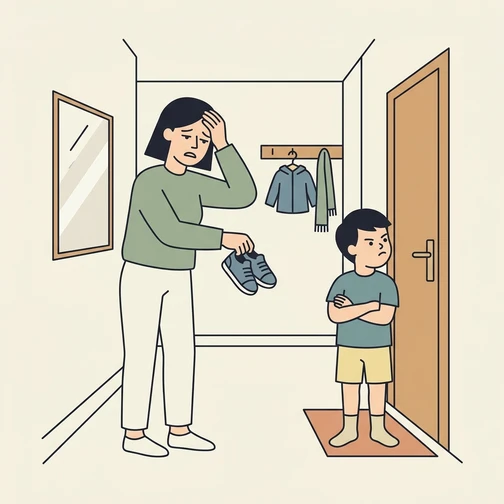
Repeated no is rarely defiance on purpose. It often comes when noise, demands or worry use up the capacity to start.

  • Too much noise blocks hearing the request.

  • Starting feels too big to picture.

  • Connection and safety come first.

  • Switching tasks costs extra energy.

What is usually not helpful when your child resists directions

  • Avoid long lectures

    Long lectures during active overload can make the request feel even heavier.
  • Do not threaten what you cannot follow through on

    Threat consequences that are hard to follow through on often increase the struggle.
  • Do not mistake overload for defiance

    Stress-induced freezing is better understood as overload than as intentional defiance.
Evidence-based sequence

A practical sequence for responding to defiant behaviour

Lower the demand

Use short language, slow gestures, and fewer words to signal safety.

Offer a micro-choice

Give two small, acceptable options to restore a sense of control.

Reinforce cooperation

Notice any small step toward follow-through with immediate praise.

Evidence-informed

NICE recommends manualized parent training for children with oppositional defiant disorder or conduct-disorder risk, using modelling, rehearsal, and feedback to change daily interaction patterns.

  • Use modelling, rehearsal, and feedback.
  • Adapt support to developmental level.
  • Use parent-child training for complex cases.
NICE CG158 - Conduct disorders in children and young people

How defiance can look across developmental stages

Select your child's age group to see how the support plan changes with age, language, and recovery needs.

Complexity
5/ 10

Support intensity changes with age, language, safety, and recovery time.

Predictable physical schedules and sensory resets

Visual routines card pack

Toddlers express noncompliance through physical resistance, rigid tantrums, and total shutdown when transitioning away from preferred activities.

A practical path to cooperation and connection

A structured set of modules you can use at home, with specialist support available if you want to go deeper.

Module 1Establish safe relational grounding15 minutes

Establish safe relational grounding

Learn to observe behaviour patterns objectively and identify the triggers that tend to show up before refusal escalates.

Cooperation baseline log

A daily tracking chart to map situational prompts and compliance rates without emotional judgment.

15 minutes
When a request turns into a battle

Help your child follow through without a power struggle

Choose one situation—getting dressed, leaving home, or homework. Get clear words and actions matched to the reason your child resists.

  • How to make the request easier to start
  • How to stay consistent without another argument
  • What to change when overload or anxiety drives refusal
Programme format

Basic self-guided pathway

Get self-paced behavioural guidance tailored to your child's developmental profile, featuring bite-size action items.

  • Interactive compliance log tools.
  • Age-specific visual guide packs.
  • On-demand prompts for reviewing hard moments.

Personalised Routine

Make one daily request easier to follow

Guided Days helps you choose the request that causes the most friction, simplify how you give it, and adjust the routine around it so cooperation has a real chance.

  • Find the moment where refusal usually starts: timing, wording, transition, or overload.
  • Rewrite the request into a shorter cue with a clear next action.
  • Track what changes when you add choice, predictability, and calmer follow-through.
A Guided Days screen showing a calmer request routine for a family
Clinical Behaviour Specialist Support

When specialist guidance adds value

If noncompliance stays severe or the pattern is hard to read, a specialist can help isolate triggers and customize behavioural strategies.

Identify triggers

We isolate the sensory, executive, and cognitive roots of noncompliance.

Customise routines

We draft environmental plans that bypass fight-or-flight reactions.

Empower follow-through

We coach you through script delivery and predictable responses.

Credentials we check
BACB logoIBAO logoQABA logo
Credentials, practical experience, and parent-training track record verified

We work with behavioural therapists who have demonstrated experience in parent training and caregiver-mediated interventions—so support works in the routines your family repeats at home.

Our direct coaching model ensures caregivers feel confident and supported, transforming stressful household standoffs into moments of relational connection.

Skills that support your parenting journey

The behavioural strategies you use at home are not temporary fixes. They form a toolkit that adapts as your child matures.

Formulating direct, single-step commands that reduce cognitive complexity and eliminate compliance friction.

Use it nowMorning schedules and evening bedtime routines

Improves school-day prep and optimizes classroom transition times.

Future situationsBuilds fundamental self-organization and independent planning skills.

Formulating direct, single-step commands that reduce cognitive complexity and eliminate compliance friction.

Support level

Choose the support level your family needs

Basic

Self-paced access to your personalised support programme and practical parent materials.

$19/ month
  • Targeted action plans for your biggest daily struggles (like sleep, tantrums, or screen time).
  • Exact words to say to de-escalate a situation in seconds.
  • Ready-to-use visual tools to make daily routines predictable.
  • Bite-sized daily steps designed for exhausted parents, taking just 5 minutes a day.

Start with your personalised programme and add expert support if needed.

Personal expert

Personalised guidance and live 1:1 sessions with an experienced, certified behavioural expert.

from $99/ month
  • A personalised support programme, built and adjusted with your expert.
  • Live 1:1 meetings with a certified behavioural specialist.
  • Direct feedback and answers to your questions.

Choose expert support when your family needs deeper, more individualised help.

Start your cooperation plan

Rebuild family harmony and restore daily cooperation

Skip the months-long paediatric waitlists. Start with a tailored self-guided plan this week and add expert support if you need it.

Self-guided plans are available now, with specialist support optional later.